RoboHarness-RL
Agentic Reinforcement Learning
for VLM-Based Robot Manipulation

Liyang Li*Mingyu Liu*Xiaoman LiZhiyue ZhaoJin-Chuan ShiCanyu ZhaoHaokai ZhangJinyuan TianLinhao ZhongHao Chen†Chunhua Shen†

Zhejiang University, State Key Lab of CAD & CG

* Equal contribution.   † Corresponding authors.

A 9B Qwen3.5 model learns to use tools, respond to feedback, and complete manipulation tasks.
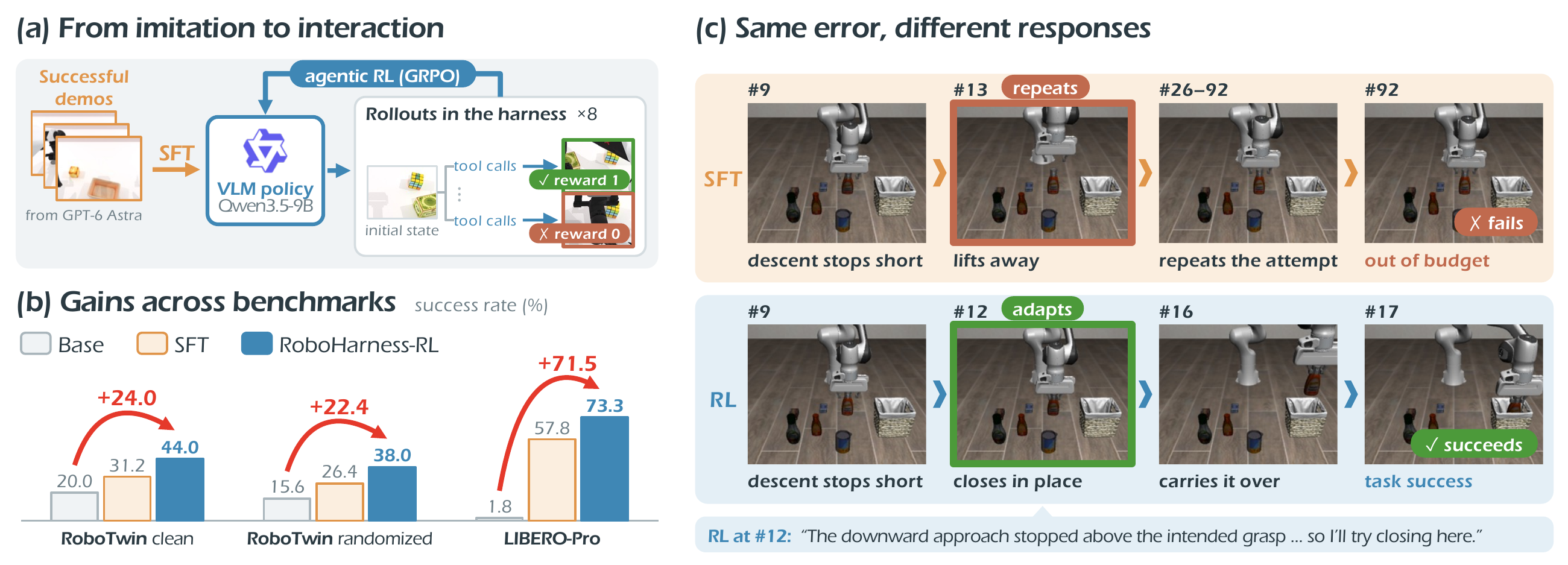
RoboHarness-RL teaser: teacher demonstrations and agentic reinforcement learning, benchmark success rates, and an example where RL adapts after an error while SFT repeats it.
RoboTwin 2.0 · clean31.2 → 44.0%SFT to RL · +12.8 points
LIBERO-Pro57.8 → 73.3%SFT to RL · +15.5 points
RoboTwin 2.0 · randomized26.4 → 38.0%Unseen scene conditions · +11.6 points

THE METHOD

A VLM policy. A robot harness.
Learning from interaction.

RoboHarness-RL trains Qwen3.5-9B to issue perception, planning, and control tool calls.
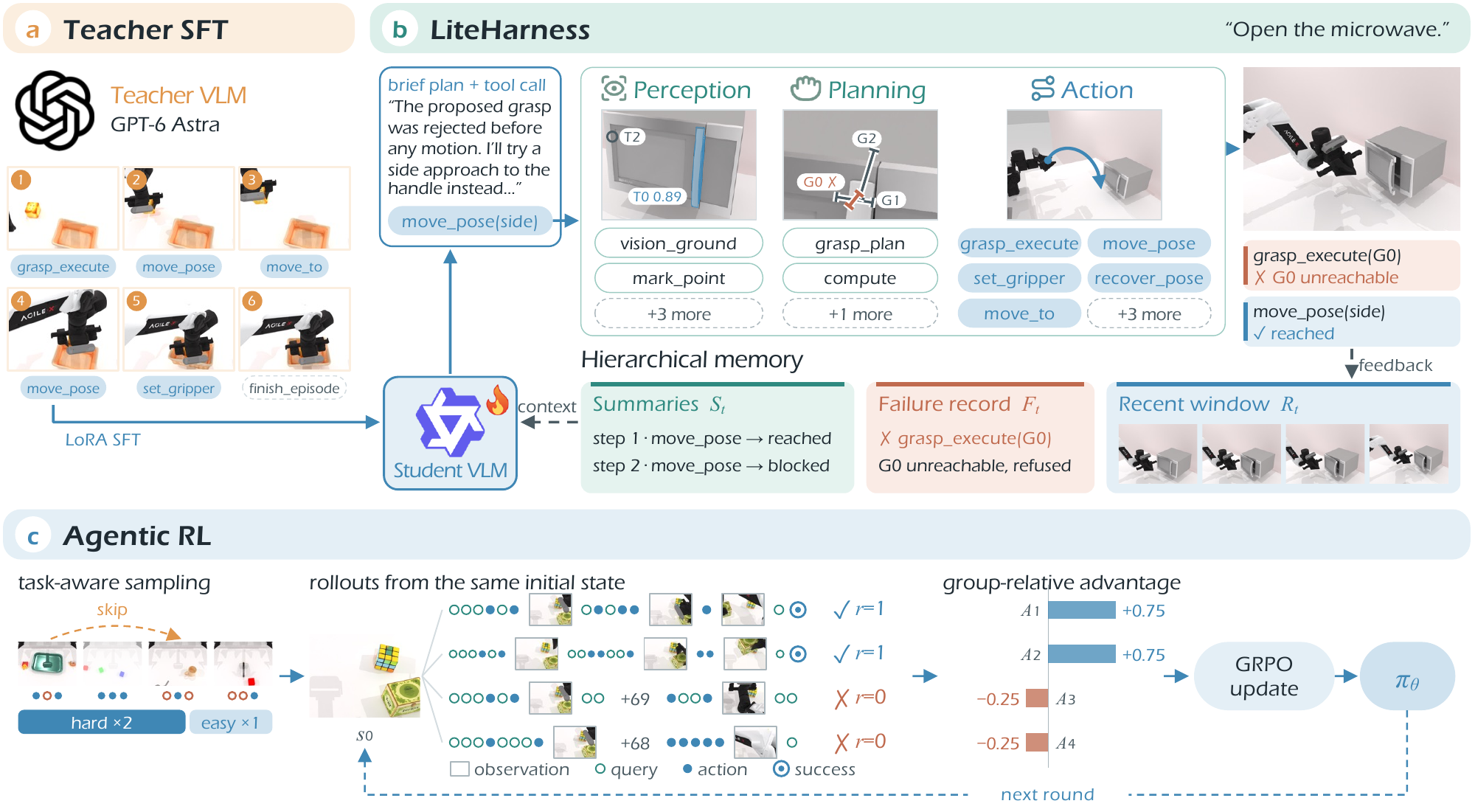
RoboHarness-RL framework showing LiteHarness and two-stage policy training
The VLM specifies actions through tools; no VLA or world action model generates the actions.

Higher success. Less repetition.

SFT and RL use the same 9B backbone and LiteHarness, evaluated on matched instances.

Task success

RoboTwin · clean

SFT
31.2%
RL
44.0%

+12.8 percentage points

LIBERO-Pro

SFT
57.8%
RL
73.3%

+15.5 percentage points

RoboTwin · randomized

SFT
26.4%
RL
38.0%

+11.6 percentage points

Repetitive calls

RoboTwin · clean

SFT
10.4%
RL
2.8%

7.6 percentage points lower

LIBERO-Pro

SFT
9.1%
RL
5.7%

3.4 percentage points lower

RoboTwin · randomized

SFT
10.9%
RL
2.5%

8.4 percentage points lower

More Examples

Selected successful evaluation episodes from the round-25 RL policy. Replays run at 1× simulation time; model inference and query waiting time are omitted. Use the video controls to enable action and feedback captions.